

In the feminine care market, “organic” has moved from a nice extra to something many shoppers expect from premium brands. Customers read labels, ask about materials, and pay attention to what sits against sensitive skin for many hours a day. For brands developing organic cotton period underwear, the fabric you choose shapes comfort, marketing claims, and how easily you can sell into stricter markets.
This guide explains what organic fabrics can and cannot do in a period product, so you can decide whether they fit your line. Shanhao is GOTS certified (see our certificate). If you are still comparing options, you can browse our OEM underwear products to see our available product range and customization options.
Table of Contents
- Comfort: why skin-contact fabric matters
- Performance: is natural fabric weaker?
- Sustainability you can actually explain
- Compliance and market access
- GOTS, OEKO-TEX and what each one means
- Our GOTS and other certifications
- Where organic cotton sits in a period underwear construction
- Checklist before you order organic samples
- Frequently asked questions
- Conclusion
1. Comfort: Why Skin-Contact Fabric Matters
The first thing a customer notices about period underwear is how it feels. The gusset and body fabric sit against sensitive skin for hours, sometimes a full day, so the material touching the skin is a big part of the product experience.
- Fewer processing chemicals: Organic cotton is grown without synthetic pesticides, and certified organic processing restricts many harsh chemicals used in conventional finishing. Many customers with sensitive skin look for exactly this.
- Breathability: Cotton fibers are naturally breathable, which helps air move around the body and keeps the garment feeling less warm and damp than some fully synthetic alternatives.
- Soft hand-feel: Gentler processing helps fibers keep their natural softness, which supports the “second skin” feel people want in underwear worn for long hours.
Be careful with health wording in your own marketing. “Made with organic cotton” and “chosen for sensitive skin” are safer than promising to cure itching or protect vaginal health. Skin reactions have many causes, and medical claims need medical evidence.
2. Performance: Is Natural Fabric Weaker?
A common belief is that natural fibers cannot perform as well as synthetics in period products. The truth is more balanced.
- Moisture handling: Cotton is naturally hydrophilic, meaning it attracts and absorbs water. In a well-designed layered gusset it can work well as a comfortable, moisture-friendly layer against the skin.
- Drying time: Cotton usually dries more slowly than synthetic microfiber. Blends or a well-planned layer order can balance comfort and drying speed.
- Durability: Wash durability depends on yarn quality, knit structure, finishing, and care instructions as much as on the fiber. Ask for wash testing on your actual construction rather than assuming.
Organic bamboo-based and other eco-fiber options exist too, each with different absorbency, stretch, and drying behavior. The best choice depends on your target customer, price, and product positioning. Our underwear manufacturing process and FAQs explain how fabric choice, layer construction and quality control work together in development.
3. Sustainability You Can Actually Explain
Shoppers are skeptical of vague “eco-friendly” wording, so specific, provable statements work better than broad ones.
- Farming practices: Organic cotton farming avoids synthetic fertilizers and pesticides, which reduces certain chemical inputs and runoff risks.
- Soil health: Organic systems commonly use practices such as crop rotation to maintain healthy soil.
- End of life: Cotton fiber itself is biodegradable, but a complete period garment also contains elastics, threads, and often a leak-resistant barrier layer. Describe the fabric honestly rather than calling the whole product biodegradable.
4. Compliance and Market Access
Chemical regulations for textiles are getting more attention in Europe (for example REACH) and in the United States (for example California’s Proposition 65). Certified organic textile supply chains are audited and traceable, which can make documentation and supplier conversations easier.
Organic certification does not replace testing for your target market, though. Confirm the requirements for each country you plan to sell in, and ask your manufacturer which reports can be provided for your finished product.
Choosing a manufacturer that understands documentation matters here. You can learn more about Shanhao’s factory and manufacturing capabilities before you plan your first development order.
5. GOTS, OEKO-TEX and What Each One Means
These two labels are often mixed up, but they cover different things.
- GOTS (Global Organic Textile Standard): Covers the organic status of the fiber and requires environmental and social criteria across the processing chain. A product generally needs certified operators throughout the chain before it can carry the GOTS label. Labeling grades also differ: a product labeled “organic” needs a higher share of certified organic fiber than one labeled “made with organic materials.”
- OEKO-TEX STANDARD 100: Tests textile materials for harmful substances at the product level. A fabric can be OEKO-TEX certified without being organic.
Ask your supplier which certificate applies to which material, who issued it, and whether it covers your finished garment or only the raw fabric. This is the kind of question we cover in our underwear manufacturing FAQs.
Our GOTS and Other Certifications
Shanhao holds a Global Organic Textile Standard (GOTS) Version 6.0 Scope Certificate. IDFL certifies that Shantou Shanhao Knitting Co., Ltd. meets the standard, under certificate number 23-485657. For brands planning GOTS certified organic period underwear, this means you can discuss certified organic fabrics with a manufacturer that already works within the GOTS system.
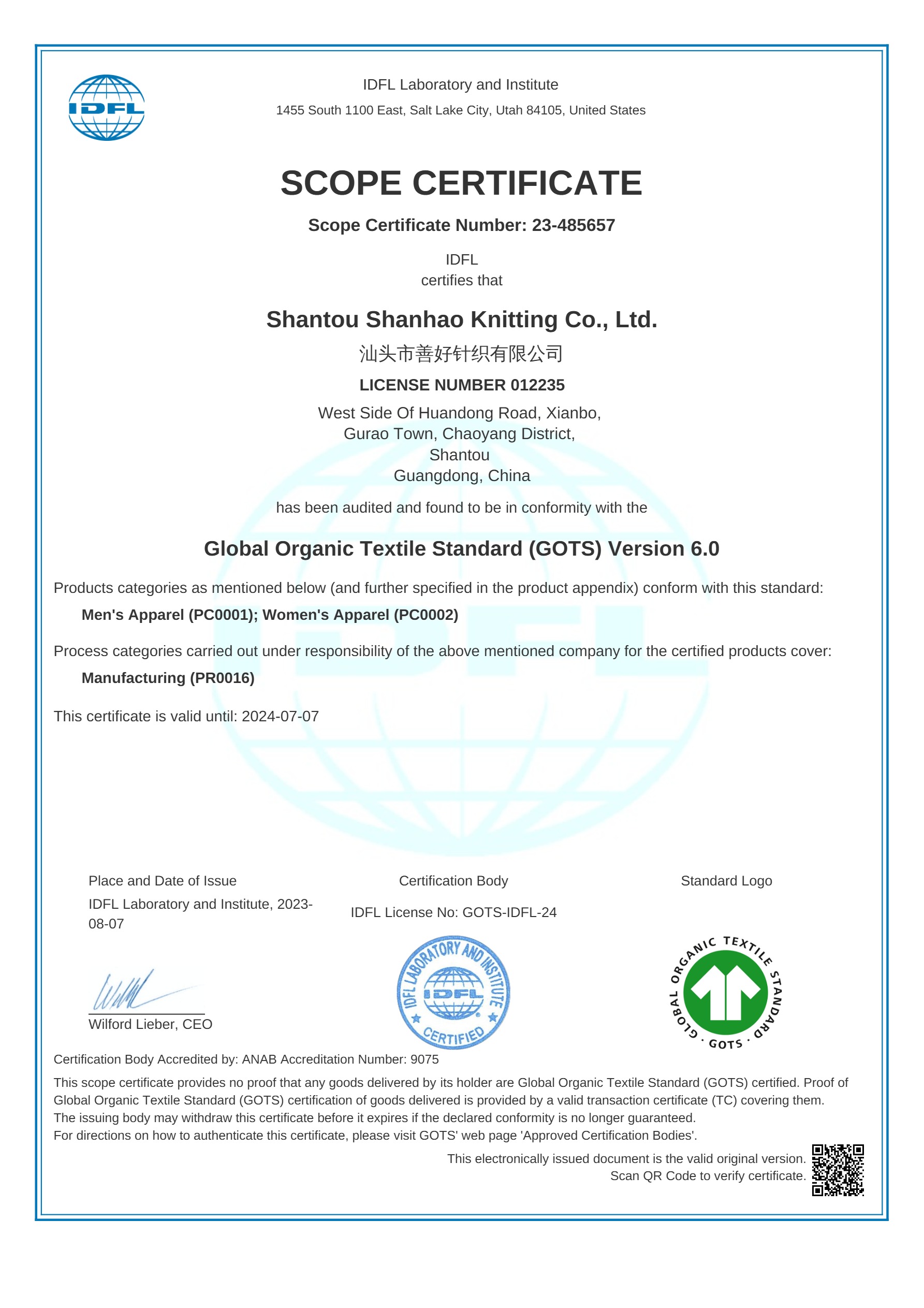
A scope certificate lists the products and processes it covers, so please confirm the scope for your specific fabric and style at the start of your project. GOTS certificates can also be checked in the public GOTS database, and we are happy to share certificate details when you request samples or a quote.
GOTS is one part of our documentation. Our factory also holds other third-party certificates that are relevant when you build a period underwear line:
- OEKO-TEX STANDARD 100: tests textile materials for harmful substances, a common requirement for skin-contact products.
- OCS (Organic Content Standard): verifies the organic fiber content of a product and tracks it through the supply chain.
- GRS (Global Recycled Standard): verifies recycled content for brands that want to combine organic and recycled materials.
- ISO 9001 (quality management): covers the quality management system behind production.
- BSCI / amfori monitoring: an ethical manufacturing and social compliance audit.
- FDA registration: registration of the facility for brands selling into the United States.
Each certificate covers a specific scope, product group, and validity period, and some are held by the factory rather than applying to every finished garment. Ask us which ones apply to your fabric and style. You can also see the full set on the certifications section of our homepage.
6. Where Organic Cotton Sits in a Period Underwear Construction
Period underwear is a layered product. Typically the top layer against the skin is a soft, comfortable fabric such as organic cotton, followed by absorbent layers and a leak-resistant barrier. The barrier and some absorbent layers are usually made from other materials, so “organic” normally describes the skin-contact and outer fabrics rather than every layer in the gusset.
Explain this clearly on your product page. It keeps your claims accurate and builds trust with informed customers.
7. Checklist Before You Order Organic Samples
- Fiber content: What percentage of each fabric is certified organic?
- Certification scope: Which certificate covers the fabric, and which covers the finished garment?
- Construction: Which layers are organic and which are not?
- Performance testing: How were absorbency, shrinkage, and wash durability tested?
- MOQ and lead time: What are they for your exact fabric, color, and style?
- Documentation: Which reports can you use to support your marketing claims?
Frequently Asked Questions
Is organic cotton period underwear as absorbent as regular period underwear?
Absorbency depends mostly on the gusset construction and layers, not only on the skin-contact fabric. Organic cotton can be used in a well-engineered layered design, and the stated absorbency should always come with a clear test method.
What is the difference between GOTS and OEKO-TEX?
GOTS focuses on organic fiber and the processing chain, while OEKO-TEX STANDARD 100 tests for harmful substances in the textile. They answer different questions and can be used together.
Can I sell my period underwear as “organic”?
Only if the product and supply chain meet the rules of the label or certification you use. Ask your manufacturer what certification covers and how it should be worded.
Does organic fabric cost more?
Usually yes, because certified organic materials and audited supply chains add cost. Many brands offset this with premium positioning, but the right balance depends on your target price.
Can I get a private label organic period underwear collection made?
Yes. OEM/ODM development can include fabric selection, styles, colors, labels, packaging, and internal construction, depending on factory capabilities and minimum order requirements. Shanhao holds a GOTS Version 6.0 scope certificate (No. 23-485657), so certified organic fabrics can be part of your project. See our OEM underwear products for customization options.
Conclusion
Organic fabric can strengthen a period underwear brand through comfort, a clearer sustainability story, and easier conversations about compliance. It works best when you understand what it does and does not cover: a certified skin-contact layer is not a guarantee for every layer of the garment, and every claim should be backed by documentation.
Ready to develop your own line? Explore our OEM underwear products, learn about Shanhao’s factory and manufacturing capabilities, or contact our team with your requirements.
Planning an Organic Period Underwear Collection?
Send us your target market, preferred fabrics, design ideas and expected order quantity, and our GOTS-certified team will help you plan the right materials and construction.