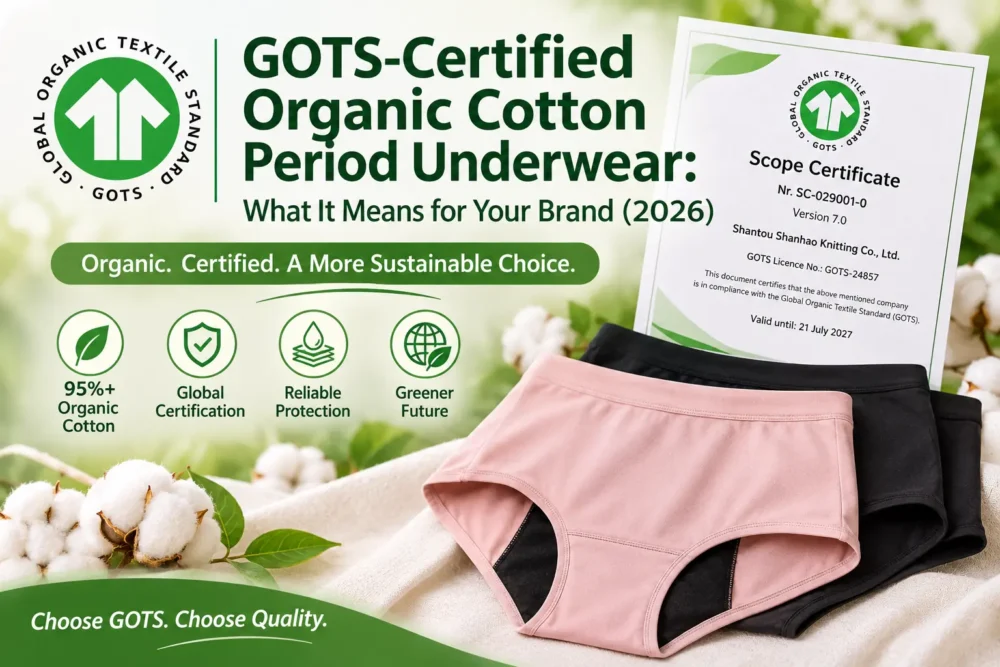
Organic is no longer a niche claim in period underwear — it is becoming a sourcing requirement. This week, GOTS certification made the trade news again when another Chinese period underwear factory announced its certification, and more brands are now asking factories for organic cotton options before they talk about price. If your brand is one of them, here is what GOTS actually means, what it does not mean, and what to ask before you order.
What GOTS actually certifies
GOTS — the Global Organic Textile Standard — is the leading worldwide standard for textiles made from organic fibres. It does not only certify the cotton. It covers the whole chain: processing, manufacturing, packaging, labelling, trading and distribution. That means the dyes and chemicals used, the water and energy in production, and the working conditions in the factory are all part of the standard — not just the fibre in the field.
That is why buyers ask for it. A GOTS label is a third-party statement about how the product was made, and it is the standard most retailers and importers recognise when a brand says “organic”.
The two label grades — and the 95% rule
GOTS has two label grades, and the difference matters for what you can print on your packaging:
- “Organic” — the product must contain at least 95% certified organic fibres.
- “Made with organic materials” — the product must contain at least 70% certified organic fibres.
A period panty with a 95% organic cotton body and 5% elastane, for example, can carry the “organic” grade. A blend with less organic fibre cannot — even if the cotton in it is organic. When a factory quotes you an organic style, ask which grade it reaches and what the exact fibre composition is. The answer should be a number, not a word.
Scope certificate vs transaction certificate — the check buyers miss
This is the part most brands get wrong. There are two different GOTS documents, and they prove different things:
- A scope certificate says a factory is certified to make GOTS products, and lists which product categories and production steps are covered. It does not certify any single order.
- A transaction certificate proves the organic status of one specific shipment — the fibre, the quantity, the buyer and the seller. It is issued per order.
A scope certificate alone does not make your panties organic. Your shipment needs its own transaction certificate, and your brand should ask for it with every order. If a factory shows you a scope certificate and calls the job done, that is a warning sign.
What to ask your factory
Before you place an organic order, ask for these five things:
- The GOTS licence number — and check it is current.
- The scope certificate — does it cover the product you are ordering, and is it still valid?
- The fibre composition — exact percentages, and which label grade that reaches.
- A transaction certificate for your shipment — issued per order, naming your company as the buyer.
- The dyes and finishes — GOTS restricts the chemicals allowed in processing, so ask what is used on your fabric.
A factory that can answer all five without hesitation is a factory that has done this before.
Shanhao and GOTS
Shanhao holds GOTS licence GOTS-24857, with current scope certificates covering men’s and women’s apparel manufacturing — 22-406152 (Version 6.0, valid to 7 July 2027), 24-629765 (Version 7.0) and SC-029001-0 (Version 7.0, valid to 21 July 2027).
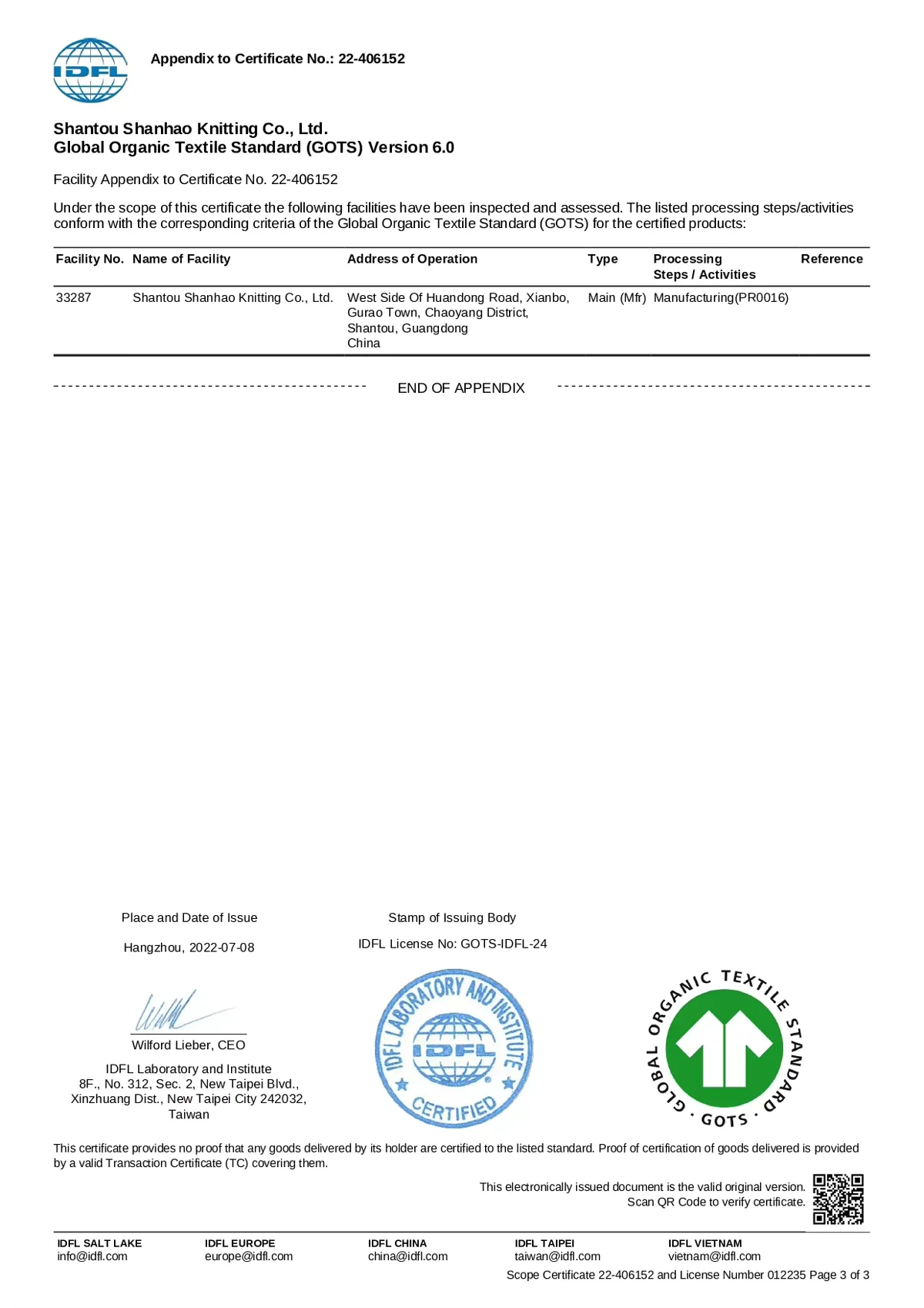
That means Shanhao can manufacture GOTS-certified organic cotton period underwear for your brand, with a transaction certificate issued for your shipment. The fibre composition, the label grade and the organic content are agreed with you before production — and the certificate for your order names your company as the buyer.
One honest note: the GOTS licence covers the manufacturing. Whether your finished panty can carry the “organic” label depends on the fabric you choose — a 95% organic cotton body reaches it, a lower blend does not. We will tell you which grade your style reaches before you order, so the claim on your packaging matches the certificate behind it.
Frequently asked questions
It means the product was made under the Global Organic Textile Standard, which covers the organic fibre, the processing, the chemicals used, and the working conditions — the whole chain, not just the cotton. A GOTS label is a third-party certification, not a factory’s own claim.
A scope certificate says a factory is certified to make GOTS products and lists what it may produce. A transaction certificate proves the organic status of one specific shipment. Your order needs its own transaction certificate — the scope certificate alone does not make your panties organic.
At least 95% certified organic fibres for the “organic” grade. Products with 70% to 95% organic fibres use the “made with organic materials” grade instead. Always ask for the exact fibre composition.
Yes. Shanhao holds GOTS licence GOTS-24857 with current scope certificates, and can manufacture organic cotton period underwear for your brand with a <a href=”https://shanhaoundies.com/product-inquiry/”>transaction certificate</a> issued for your shipment.
Want an organic cotton period underwear line with the certificates to back it? Request a quote and tell us your styles, fibre mix and target market. Or browse the OEM range.