
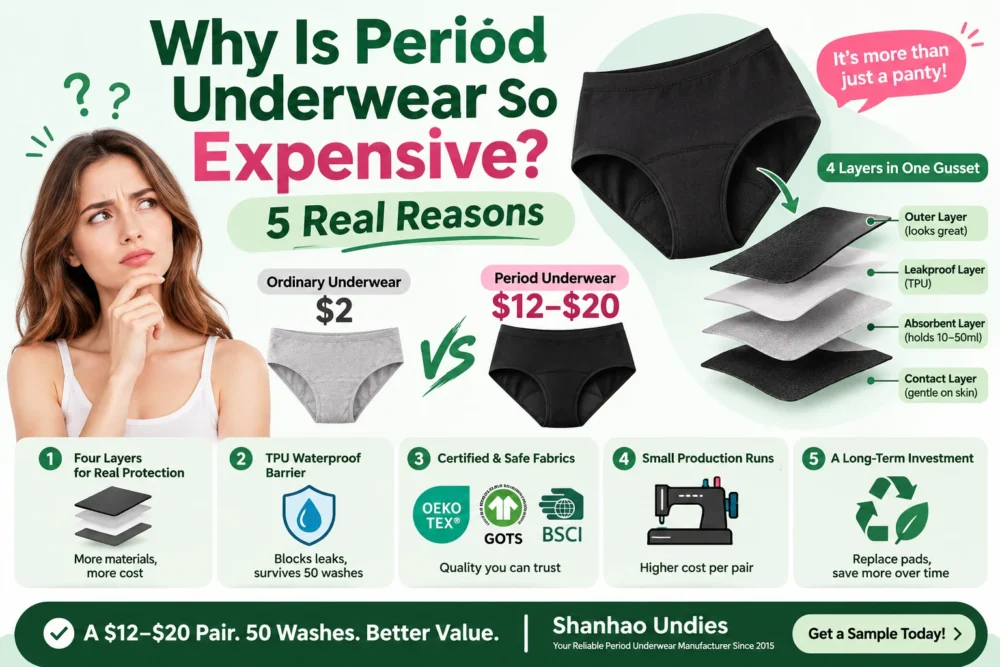
A pair of period underwear typically costs $12–$20 at retail. Next to a $2 pair of ordinary cotton underwear, that looks expensive. It is not a markup trick. A period pair is a different product: it has to hold fluid, stay dry on the outside, survive about 50 washes, and sit against skin for hours. Every one of those jobs adds a layer, a material, or a test — and each one costs money. Here are the five real reasons.
1. It is not one piece of fabric — it is four layers
An ordinary pair of underwear is one layer of fabric. A period pair is four, bonded into one gusset:
- Contact layer — the fabric against skin, usually cotton, modal or bamboo.
- Absorbent layer — the core that holds the fluid. Our patented construction holds 20–100 ml in the absorbent layer, depending on the style: a thong holds around 10 ml, a bikini or brief around 20–30 ml, a boyshort up to 40–50 ml.
- Leakproof layer — the barrier that stops fluid reaching the outside.
- Outer layer — the fabric the world sees, which has to look and feel like normal underwear.
Four layers have to be cut, aligned and bonded so the gusset stays flat, does not bunch, and does not leak at the edges. That is four materials, four cutting steps and a bonding step an ordinary pair never needs. Read our full guide to absorbency levels and how to test them: Period Underwear Absorbency Guide
2. The waterproof layer is TPU — and it has to be the right one
The leakproof layer is usually TPU (thermoplastic polyurethane) or PU. TPU is the standard for washable leakproof layers: it blocks liquid, survives repeated washing, and stays flexible. A cheap pair often uses a thinner barrier, or a PU coating that cracks after a few washes. Once the barrier fails, the pair leaks — and no amount of absorbent fabric above it can fix that.
In our own testing, the difference between a $1 pair and a $4 pair is exactly this: 2 layers versus 4. Same look on the outside, different inside. That is why a price that looks too good usually is.
A cheap barrier also ages badly. A thin PU coating can crack after a few washes, and once it cracks the pair leaks no matter how much absorbent fabric sits above it. A proper TPU layer survives about 50 washes — the same lifespan as the pair itself.
The price by style: why a boyshort costs more than a thong
Not all period underwear costs the same to make, and the style explains much of the difference:
- A thong holds around 10 ml. Smallest gusset, least absorbent core, least fabric — the cheapest to make.
- A bikini or brief holds around 20–30 ml. A bigger gusset and more core material.
- A boyshort holds up to 40–50 ml. The largest gusset, the most absorbent core, the most fabric — the most expensive to make.
So when a factory quotes a price, the ml rating and the style explain it more than the label does. A heavy-flow boyshort should cost more than a light-flow thong, because there is physically more of the expensive part — the absorbent core — inside it.
3. Certified fabrics cost more — and the testing is not free
Period underwear sits against skin for hours, so what is in the fabric matters. A reliable factory pays for:
- OEKO-TEX STANDARD 100 — every component tested for harmful substances. Our certificate is 26.HCN.11739, valid until 28 February 2027, and the scope includes period panties.
- PFAS testing — a test report, not a promise. Our PFAS test report is TAOEC25009680701.
- ISO 9001, GOTS and BSCI — quality management, organic cotton certification and social compliance audits.
Each certificate means lab tests, audits and annual renewals. A factory that skips them can sell cheaper — and a buyer has no way to know what is in the fabric. Read our full guide: PFAS-Free Period Underwear Buyer Guide
4. Small runs, not mass production
Ordinary underwear is made in runs of tens of thousands. Period underwear is made in much smaller runs, and custom work is smaller still:
- Ready stock: no minimum order.
- Standard designs: around 100 pieces per style.
- Full custom — your logo, packaging, colours or designs: minimum 1,000 pieces for each custom element.
A sample costs around $10 for stock and $20 for a new panty design ($30 for a bra design), because the factory has to make the pattern first. Production takes 10–40 days after sample approval. Small runs mean the cost of the pattern, the tests and the setup is spread over fewer pairs — so each pair carries more of it. That is the opposite of fast fashion, and it is why the price cannot match a mass-market brief.
If you are comparing factories, not just prices, start here: 10 period underwear manufacturers in China
5. It replaces years of disposables
The sticker price is not the real price. A pair that costs $12–$20 and lasts about 50 washes works out to roughly $0.24–$0.40 per wear. Over a lifetime, disposable pads add up to thousands of dollars — our cost-per-wear comparison puts it at about $4,800 — plus the waste of every pad thrown away.
So the honest comparison is not “$15 versus $2”. It is “$15 once, worn 50 times” versus “$2, worn once, plus a pad every time”. Read the full comparison: Period Underwear Cost Per Wear
What you pay for, at a glance
| Ordinary underwear | Period underwear | |
|---|---|---|
| Layers | 1 | 4 — contact, absorbent, leakproof, outer |
| Waterproof barrier | None | TPU layer |
| Absorbency stated in ml | No | Yes, per style (10–50 ml) |
| Certifications | Rarely tested | OEKO-TEX, PFAS test report |
| Lifespan | Until it wears out | About 50 washes |
| Replaces while worn | Nothing | Pads and tampons |
See the full range: OEM product range
Quick check — is the price fair?
Before you buy — or before you choose a supplier — check these five things:
- The gusset has 4 layers, and the factory can name them
- The waterproof layer is TPU, not an unnamed coating
- The OEKO-TEX certificate number is current and covers period panties
- There is a PFAS test report with a number, not just a claim
- The absorbency is stated in ml per style, and you can pour-test the sample yourself
If a pair passes all five, the price is paying for something real. If it fails three or more, the low price is the warning, not the bargain. Read our supplier checklist: How to Tell a Reliable Period Underwear Factory from a Risky One
Frequently asked questions
Because it is four layers bonded into one gusset — contact, absorbent, leakproof and outer — plus a TPU barrier, certified fabrics and testing, made in small runs. An ordinary pair is one layer of fabric made in runs of tens of thousands.
Usually fewer layers and a cheaper barrier. In our comparison, a $1 pair had 2 layers where a $4 pair had 4. The outside looks the same; the difference is what you cannot see — and it shows up after a few washes, when the barrier fails.
Do the per-wear math. A $12–$20 pair lasting about 50 washes costs roughly $0.24–$0.40 per wear, and replaces disposables every time you wear it. A cheap pair that leaks after five washes costs more per wear — and costs you the confidence to wear it at all.
About 50 washes with the right care: rinse cold, wash at 40 °C maximum, hang dry. Machine drying shortens its life. Read our care guide: How to Wash Period Underwear
No. Price also includes brand, retail margin and design. A $40 pair is not automatically twice as absorbent as a $20 pair. Judge by the same five checks: layers named, TPU barrier, current OEKO-TEX number, PFAS test report, and ml per style — then pour-test the sample yourself.
Shanhao has manufactured period underwear since 2015 — 500,000 units a month, 300,000 panties and 200,000 bras, across 7 production lines. Send your tech pack and get a sample plan in 48 hours, or browse ready stock with no minimum order.